






A $5 million law firm can look successful from the outside while running on owner intervention, late financial reports, inconsistent billing follow-up, and managers who lack authority to act. That is not a growth problem. It is a legal leadership problem.
Revenue can conceal weak management for years. More matters come in, capable people work harder, and the owner solves the exceptions. Eventually, the firm reaches a point where every new attorney, practice group, office, or service line adds more complexity than profit. The answer is not another motivational speech or a new software purchase. It is leadership that turns the firm into an accountable operating business.
What Legal Leadership Actually Means
Legal leadership is not simply being the most experienced attorney in the room. It is the discipline of setting direction, assigning decision rights, measuring execution, and holding people accountable for results.
A firm owner may be excellent at attracting clients, producing high-quality work, and maintaining relationships. Those strengths matter. But they do not automatically create a scalable firm. Scale requires leaders who can run functions, solve problems within clear boundaries, and improve performance without waiting for the owner to approve every move.
This distinction matters because many firms confuse authority with leadership. The managing partner has authority. The administrator has responsibility. Department heads have titles. Yet no one owns specific business outcomes such as collections performance, capacity planning, client intake conversion, staff retention, or matter profitability. When ownership is unclear, problems become recurring conversations instead of resolved issues.
Effective leadership creates a management system where every critical outcome has an accountable owner, a measurable standard, and a regular review cadence.
The Owner Dependence Test
The fastest way to assess leadership quality is to examine what happens when the owner steps away for two weeks. Not a working vacation with constant calls and email approvals. A genuine absence from daily decision-making.
If billing slows, hiring stalls, client issues escalate, priorities change, or team members wait for direction, the business is still owner-operated. That model can produce income, but it rarely produces freedom or meaningful enterprise value.
Owner dependence is often defended as quality control. Sometimes that concern is legitimate, especially in a firm with complex work or high-stakes client relationships. But owner involvement should be intentional, not the default operating model. The owner should remain involved in decisions that require judgment, relationships, or strategic direction. The owner should not be the approval point for routine exceptions, overdue time entries, staff conflicts, or every operational decision.
The practical question is not, “Can someone else do this exactly as I would?” The better question is, “What system, authority, training, and scorecard would allow a competent leader to own this outcome?”
That shift is where scalable firms begin.
Build Leadership Around Business Functions
A firm does not need layers of corporate bureaucracy to lead well. It does need clarity across the functions that determine whether growth creates profit or chaos.
Financial Leadership
Financial leadership means more than reviewing a monthly profit and loss statement. Someone must own the full financial cycle: time capture, billing timeliness, realization, collections, compensation discipline, cash forecasting, and matter-level economics.
Many owners receive financial reports too late to make useful decisions. By the time they see a margin decline, the underlying issue may have been building for a quarter. A leadership team needs a short list of leading indicators reviewed weekly or biweekly. Unbilled work, accounts receivable aging, collection commitments, payroll percentage, and capacity utilization provide earlier warning than year-end results.
The trade-off is that more measurement can become noise. The answer is not a dashboard with 40 metrics. It is a scorecard with a small number of measures that leaders can influence and are expected to explain.
People Leadership
Most firms do not have a hiring problem. They have a performance management problem that begins after hiring.
Strong leaders define what good performance looks like by role. They set expectations during onboarding, provide regular feedback, address underperformance early, and make compensation decisions based on contribution rather than tenure or personal comfort. This is especially important in firms where a talented employee has become indispensable despite creating friction, avoiding accountability, or resisting needed change.
A high performer who weakens the management system is expensive. The cost shows up in turnover, delayed decisions, poor morale, and the owner’s lost time. Leadership requires the willingness to address that cost directly.
Operational Leadership
Operational leadership creates repeatable execution across intake, matter opening, staffing, workload allocation, billing workflows, client communication standards, and administrative support.
The goal is not to force every team member into a rigid script. Different practice groups and client relationships may require different workflows. The goal is to eliminate preventable variation in the processes that affect speed, profitability, and client experience.
When a process fails, strong leaders do not immediately blame an employee or add another meeting. They diagnose the system. Was the expectation clear? Was the handoff defined? Did the team have the right capacity? Was there a measurable standard? Was anyone reviewing performance before the issue became urgent?
That diagnostic approach prevents firms from treating symptoms while the underlying operating problem remains untouched.
Create a Real Management Cadence
Leadership is visible in meetings, but meetings alone are not management. A productive management cadence has a defined purpose, reliable data, clear decisions, and follow-through.
A weekly leadership meeting should focus on performance against scorecards, obstacles requiring cross-functional decisions, and commitments due before the next meeting. It should not become a roundtable of updates that could have been read in advance.
Monthly meetings should look deeper at financial results, staffing capacity, operational trends, and strategic priorities. Quarterly sessions should test whether the firm’s structure, goals, and resources still support the next stage of growth. As revenue increases, informal communication becomes less reliable. Cadence replaces assumptions with visibility.
The critical element is the action register. Every decision needs one owner and a due date. “The team will look into it” is not accountability. It is a delay disguised as collaboration.
Give Managers Authority Before You Demand Accountability
Law firm owners frequently ask why their managers do not take more initiative. The answer is often simple: managers have responsibility without authority.
A billing manager may be expected to improve collections but lack the authority to enforce billing deadlines. An operations leader may be accountable for staffing efficiency but unable to challenge attorney workload assumptions. An executive director may be charged with running the business while partners make individual exceptions that undermine every agreed process.
Accountability without authority creates frustration. Authority without accountability creates inconsistency. Legal leadership requires both.
Decision rights should be explicit. Managers need to know what they can decide independently, what requires consultation, and what must be escalated. Owners also need to respect those boundaries once they are established. Overriding managers casually may feel efficient in the moment, but it trains the organization to bypass leadership.
Use Data to Drive Better Conversations
Data does not replace judgment. It improves the quality of the conversation around judgment.
For example, if a practice group reports that it is overwhelmed, leadership should be able to examine demand, available capacity, turnaround times, realization, utilization, and staffing mix. Without that information, the loudest voice often wins. With it, the firm can decide whether to hire, redistribute work, adjust pricing discipline, improve workflow, or address a performance issue.
The same principle applies to profitability. A firm-wide revenue number is not enough. Owners need to understand which teams, matters, and client relationships are producing economic value and which are consuming disproportionate time and attention. Not every low-margin relationship should end immediately. Some serve strategic purposes. But those choices should be deliberate, not invisible.
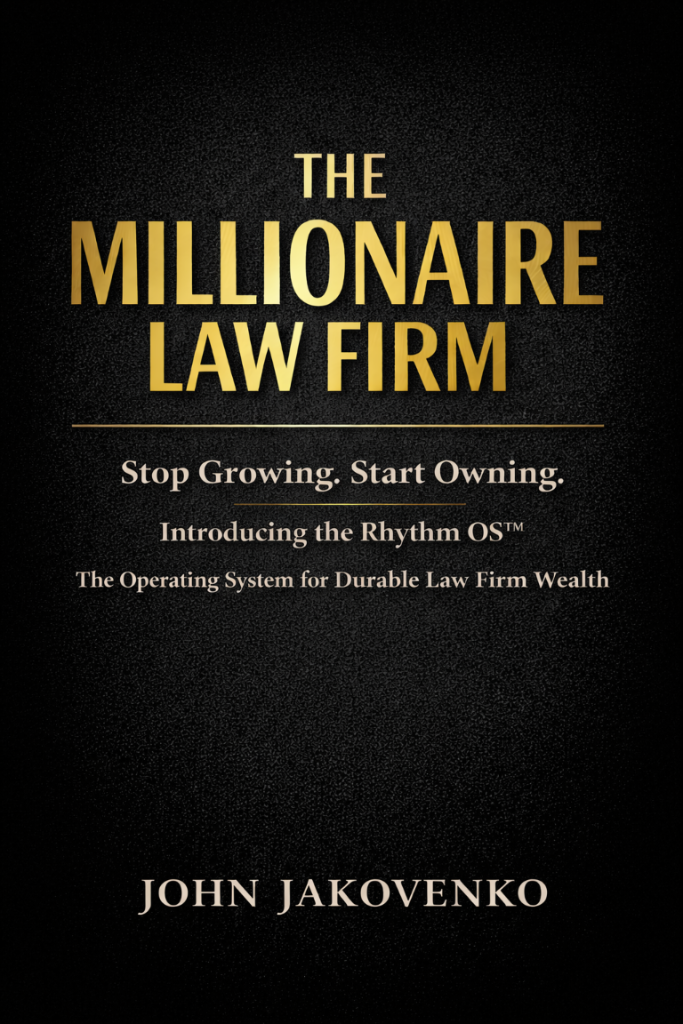
Rhythm OS™ is built around this operating reality: leadership, finance, people, operations, marketing, and client service must work as one management system. Improving one function while ignoring the others usually shifts the bottleneck rather than solving it.
Make Leadership a Firm Capability
The best leadership model is not one where the owner becomes unnecessary. It is one where the owner is no longer required for ordinary execution.
That requires a deliberate bench of leaders, documented decision rights, visible scorecards, and a consistent operating cadence. It also requires owners to stop rewarding heroics that compensate for broken systems. The attorney who rescues a matter at the last minute may deserve recognition. But the firm should still ask why the issue reached a crisis point.
A more profitable firm is usually not built by asking people to work harder. It is built by making performance easier to see, decisions easier to make, and accountability harder to avoid. Start with one question: where does the firm still need the owner to create clarity? That is where the leadership work begins.