





Impact-Site-Verification: 05f65c6e-3e2e-4de6-988d-3e1bf4ae7646Skip to main content
Fractional COO for Law Firms

Growth without freedomis just a bigger job.

I'm John Jakovenko, a fractional COO for firms with 5 to 50 attorneys. I've run operations inside hundreds of law firms. I install the system that runs yours so it stops depending on you.

Books by John Jakovenko

The Library

Four books on law firm operations, wealth, growth, HR, and AI — all available on Amazon.

The Millionaire Law Firm — Stop Growing. Start Owning.
Bestseller

The Millionaire Law Firm

Stop Growing. Start Owning.

Introducing the Rhythm OS™ — the operating system for durable law firm wealth. Not a growth playbook. An ownership framework.

Managing the Unmanageable — HR in a Law Firm

Managing the Unmanageable

HR in a Law Firm

The HR system for law firms that always felt impossible to manage — hiring, accountability, leverage, and culture built for a legal practice.

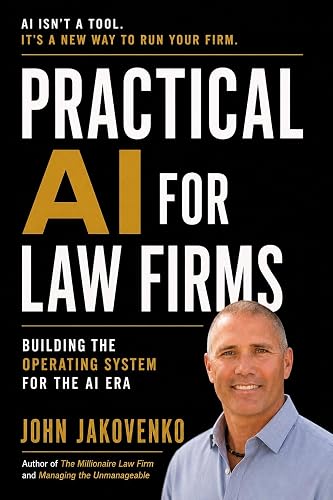
Practical AI for Law Firms — Building the Operating System for the AI Era
Top New Release on Amazon

Practical AI for Law Firms

Building the Operating System for the AI Era

How small and mid-sized law firms actually adopt AI — prompts, workflows, staff rollout, and the systems that make AI stick beyond week three.

The Little Book of Law Firm Growth — Seven Gates Between a Busy Firm and a Profitable One
New Release

The Little Book of Law Firm Growth

Seven Gates Between a Busy Firm and a Profitable One

A pocket guide to the seven gates a firm must pass — ownership, margin, cash, capacity, conversion, demand, and team — built from the owner out to the market.

📘 The Millionaire Law Firm — Now Available (Kindle + Hardcover)Get Your Copy
Rhythm OS™

Free Law Firm Diagnostics

Many law firms grow revenue but never build real owner wealth. The Rhythm OS diagnostic tools analyze your firm's financial structure and operational leverage to reveal where margin and partner time are being lost.

Profit Margin Diagnostic

Upload your firm's Profit & Loss statement and instantly calculate your operating margin, labor ratio, and overhead structure.

Law Firm Scorecard

Assess your firm's operational structure, staffing leverage, and growth readiness across key Rhythm OS metrics.

Framework

What is Rhythm OS?

Rhythm OS is a framework designed to help law firm owners convert revenue into real owner wealth.

Instead of focusing only on growth, the framework analyzes the structural drivers of profitability inside a firm:

  • ◆Collection velocity
  • ◆Staffing leverage
  • ◆Operating margin
  • ◆Owner compensation structure

These diagnostics provide a quick way to identify where firms are unintentionally compressing their own profitability.

The Operating System

Software that runs the firm — not just advice about it.

The same systems I install as your COO, packaged so your firm can run them every day. Start free. Grow into the platform. Bring me in when you’re ready to scale.

FREE TOOL

Tempus

AI passive timekeeping for attorneys. It watches your work quietly and drafts your billable time so nothing leaks.

Recover the hours you’re already working but never capturing.

PLATFORM

LawStaff

AI staff that keep every client informed, run your billing cycle, and act on your docket — communication-first, so malpractice never starts with silence.

Kill the #1 bar complaint: no communication.

DONE WITH YOU

Fractional COO

I install the operating system and the staff, then run the rhythm with you until the firm is profitable, compliant, and calm.

AmLaw 200 discipline, sized for your firm.

Free tool → platform → partner. Step on wherever you are.

What We Do

Legal Administration. That's it.

We work one-on-one with you to achieve your goals, not ours. Take the Ownership Review to identify your firm's operational gaps.

Clio Affiliate Partner

Law Firm Financial Management & CFO Advisory Services

Your Map to a More Profitable Law Firm

You know where your firm is today. But do you know exactly where your revenue, profitability, and cash flow will be six months from now? As a law firm financial consultant and fractional CFO, we help firm owners build financial clarity, predictability, and accountability — so you can stop reacting and start leading.

Law Firm Financial Statement Analysis

If you don't understand your numbers, you can't improve them.

We provide detailed law firm financial statement analysis including:

Profit & loss review

Partner compensation modeling

Expense ratio benchmarking

Revenue per attorney analysis

Payroll and staffing cost evaluation

Cash flow forecasting

Know exactly what your law firm is generating, what it's spending, and where profit is leaking.

Law Firm Budgeting & Profit Planning

Profit doesn't happen by accident.

We build structured, data-driven budgets for law firms that align:

Revenue targets

Attorney billable hour goals (yes — 1800 rhythm 😉)

Marketing investment

Staffing strategy

Partner distributions

A proper law firm budget ensures you hit your financial objectives without constantly stressing about payroll.

Law Firm Bookkeeping Oversight & Financial Controls

Overpaying for bookkeeping without strategic insight?

We provide law firm bookkeeping oversight and financial system structure so your data is:

Accurate

Timely

Categorized properly

Decision-ready

Bookkeeping should support strategy — not just compliance.

Law Firm Billing Optimization

Nothing destroys cash flow faster than weak billing systems.

We improve:

Timekeeping compliance

Billing cycle consistency

Lock-up reduction

Realization rates

Work-in-progress monitoring

Your billing practices should generate revenue — not delay it.

Law Firm Collections Strategy & Cash Flow Management

Revenue isn't real until it's collected.

We build law firm collections systems that improve:

Accounts receivable aging

Payment plan tracking

Client communication cadence

Cash forecasting

Without a structured collections process, even high-revenue firms run out of cash.

Work With a Fractional Law Firm CFO

If you're a growing law firm that needs financial leadership but isn't ready for a full-time CFO, our fractional law firm CFO services provide:

Strategic financial planning

Operational accountability

KPI tracking

Profit improvement strategy

Stop guessing. Start scaling with clarity.

Law Firm Operations Consulting & Back Office Management

From AmLaw 200 Systems to Your Law Firm

We've implemented operational systems inside AmLaw 200 firms — and we bring that same discipline and structure to growth-focused law firms across the country. Your firm is unique. But operational efficiency, financial discipline, and revenue systems follow proven frameworks. Let's build a law firm back office that runs so smoothly it becomes an afterthought — not the thing consuming your entire day.

Strategic Planning for Law Firms

Most firms don't lack ambition. They lack structured execution.

Our law firm strategic planning services include:

Operational gap analysis

Revenue and staffing alignment

Departmental performance review

Leadership accountability structure

Growth roadmap development

We evaluate where your firm is today versus where you want to be — and design a clear operational plan to close that gap.

Law Firm Process Improvement & Workflow Design

Late deliverables. Bottlenecks. Client frustration. Attorney burnout.

These are operational failures — not legal failures. We implement structured law firm workflow systems including:

Case lifecycle mapping

Intake-to-collection workflow optimization

Project management structure

Role clarity and delegation models

Task tracking systems (Monday, Asana, etc.)

Operational discipline increases both client satisfaction and firm profitability.

Law Firm Operational Analysis & Systems Implementation

You cannot improve what you do not measure.

Our law firm operational analysis includes:

Staffing efficiency review

Attorney productivity benchmarking

Administrative capacity modeling

Payroll-to-revenue ratio evaluation

Department performance metrics

We measure your current structure and implement systems that align operations with growth.

Law Firm KPI & Performance Reporting

What gets measured gets managed.

We design custom KPI dashboards for law firms that track:

Revenue per attorney

Billable hour attainment (yes — your 1800 rhythm 😉)

Realization and collection rates

Case cycle times

Marketing ROI

Staff productivity

Data removes emotion. Metrics create accountability. Accountability drives profit.

Fractional COO & Law Firm Administrator Services

If your firm needs operational leadership but isn't ready for a full-time COO or firm administrator, our fractional law firm COO services provide:

Executive-level operational oversight

Strategic planning facilitation

Leadership accountability

Departmental alignment

KPI reporting and executive dashboards

You don't need more chaos. You need operational clarity.

Law Firm Human Resources & People Operations Consulting

Building High-Performance Legal Teams

Your firm doesn't just employ staff. You lead attorneys, paralegals, intake teams, and administrators whose performance directly impacts revenue, client satisfaction, and firm culture. We provide law firm HR consulting and people operations strategy designed specifically for legal practices — not generic businesses. Because law firms are different.

Law Firm Policies & Employee Handbooks

Without structured policies and clear work rules, law firms expose themselves to unnecessary employment risk.

We draft and implement:

Law firm employee handbooks

Attorney employment agreements

Performance expectations frameworks

Compensation and bonus policies

Remote work and hybrid policies

Compliance-driven HR documentation

Proper policies reduce litigation risk and create operational clarity.

Law Firm Performance Management Systems

Great firms don't happen by accident. They're built on accountability.

We design structured law firm performance management systems that align:

Attorney billable hour targets (yes — the 1800 rhythm 😉)

Realization and collections metrics

Paralegal productivity standards

Intake conversion goals

Department-level KPIs

When expectations are clear, performance improves. When performance improves, profitability follows.

Employment Law Compliance for Law Firms

Many firm owners assume they understand employment law — because they're lawyers.

But employment law compliance is nuanced and constantly evolving. We help law firms implement:

Wage and hour compliance systems

Exempt vs. non-exempt role classification

Proper documentation practices

Termination risk protocols

Leave management processes

Protect your firm from preventable employment-related claims.

Law Firm Payroll Administration

Payroll errors damage morale and create legal risk.

We provide structured payroll oversight and administration for law firms to ensure:

Accurate compensation tracking

Bonus calculation alignment

Attorney compensation modeling

Payroll-to-revenue ratio analysis

Payroll isn't just administrative — it's strategic.

Law Firm Benefits Strategy & Administration

Attracting and retaining top legal talent requires more than salary.

We work with your benefits brokers to design cost-effective, competitive benefit packages including:

Health insurance optimization

HSA and FSA strategy

Retirement plan alignment

Cost-sharing analysis

Benefits benchmarking for law firms

The right benefits structure improves retention without crushing margins.

Fractional HR Leadership for Law Firms

If your firm needs structured HR leadership but doesn't require a full-time HR director, our fractional law firm HR services provide:

Policy development

Performance management design

Compliance oversight

Compensation structure alignment

Leadership coaching

Strong firms are built on strong people systems.

How Small & Mid-Size Law Firms Compete with Big Law

Enterprise-Level Systems Without Enterprise Overhead

Large law firms don't win because they're smarter. They win because they have systems. Financial discipline. Structured operations. Performance accountability. Dedicated administrative leadership. The truth? Mid-size and growing law firms can implement the same operational infrastructure — without the massive overhead. That's where we come in.

Enterprise-Grade Law Firm Operations

We bring AmLaw 200-level operational structure to growth-focused law firms, including:

CFO-level financial management

COO-level operational oversight

Structured HR and performance systems

KPI dashboards and accountability models

You don't need 300 attorneys to run like a 300-attorney firm. You need leadership systems.

Competitive Advantage Through Operational Excellence

Your competitive advantage is not lower rates.

It's:

Faster response time

Better client experience

Higher attorney productivity

Predictable cash flow

Professional administration

Operational excellence allows smaller firms to compete directly with larger competitors — without sacrificing profitability.

Scalable Law Firm Systems That Grow With You

Chaos doesn't scale. Systems do.

We design scalable law firm management systems that evolve as you:

Add attorneys

Expand practice areas

Increase marketing spend

Grow into multi-location firms

Growth without structure leads to stress. Growth with structure leads to dominance.

Watch

When Should You Hire an Administrator?

Discover the right time to bring professional administration into your law firm. Not sure if you're ready? Take the Ownership Review.

Who We Are

We're on a mission to run your law firm with peace of mind.

John M. Jakovenko

John M. Jakovenko

CLM, MAC, MBA, SPHR, SHRM-SCP

Firm Administrator

John is a leading expert on all things business of law. Since 2006, John has devoted his career to law firm management working with firms of all sizes and in various states. He also teaches the Association of Legal Administrators Business of Law HR courses as well as the HR section of the Legal Management Fundamentals course, helping new administrators navigate their first five years in law firms.

John M. Jakovenko with best friend

"Life's too short not to bring personality to work. Meet my partner in crime — keeping things fun while we revolutionize law firms."

Our Philosophy

Who We Are NOT

We are your trusted advisor and law firm operations specialists.

We are not administrative assistants helping you accomplish menial tasks.

We do not provide one-size-fits-all solutions.

We do not implement systems without understanding your unique practice.

We help you work smarter, make more money, and reclaim your time to focus on what you do best: practicing law. Assess your systems health in 3 minutes.

Strategic Focus

We align operations with your firm's strategic objectives, not generic best practices.

Revenue Focus

Every recommendation is designed to improve profitability and cash flow.

Proven Expertise

Experience from AmLaw 200 firms to boutique practices across multiple states.

Partnership Model

We work alongside you as an extension of your team, not just external consultants.

20+
Years of Experience
100+
Law Firms Served
4
Global Locations

Trusted by Law Firms Nationwide

Don't just take our word for it

"Our experience with The Jakovenko Group has been nothing short of transformative for our firm. John and his dedicated team bring a wealth of human resource and management expertise that truly set the foundation for our next level of growth. His impact on our firm, and on me personally, has been immeasurable."

Law Firm Partner

"John has helped me make huge steps in the operation of my firm. It's allowed me to start 'working on my business' instead of 'working in my business'. He's patient and helps you see your blind spots. I can't recommend him enough."

Boutique Law Firm Owner

"I am part of a boutique law firm that has retained John's services, and he is an amazing resource. He is adaptive to the needs of his clients, and tailors solutions to their specific areas and goals. Our firm doesn't want to lose that character of what makes it unique, but also understands that with expansion comes evolution."

Law Firm Partner

"Working with John has been nothing but a pleasure. He's always ready to teach, help or guide you. Since working with him, our firm has improved immensely and continues to excel!"

Law Firm Administrator

"John jumped in when the organization needed him. He brought his expertise, calm/cool, and sense of humor with him. He is relatable, reliable and even."

Legal Organization

"Extremely competent, Efficient, Easy to Work with and Always Available. Highly recommend. He did a Great Job!"

Law Firm Client

What's keeping you up at night?

Are you ready for the next level of

legal administration?

LegalAdministrator.ai|

The AI Workforce for Law Firms

Big-law departments. Solo-firm payroll.

Lawstaff is the AI operations staff for small law firms — trained on your firm, governed by your playbooks, and supervised by you. Reception, intake, research, case management, billing, collections, and marketing, each with a name and a specialty.

40%

of a solo attorney's day is unbillable admin work

78%

of callers hire the first firm that actually answers

$118k

average unbilled time lost per lawyer, per year

A Workforce, Not a Chatbot

Eleven AI staff members — reception, intake, research, billing, collections, marketing — each with a name, a specialty, and real KPIs.

The Approval Gate

Nothing reaches a client, a court, or your books without your sign-off. Autonomy where it is safe; your hand where it is law.

Numbers You Can Manage

Every staff member carries real numbers — response time, matters moved, time captured, AR recovered — and is measured on them.

Meet the firm behind your firm

AT

Atticus

Legal Administrator

PE

Pearl

Receptionist

MA

Marlowe

Intake Specialist

HA

Harper

Legal Assistant

LX

Lex

Research Attorney

CA

Casey

Case Manager

QU

Quinn

Billing Clerk

MR

Marshall

Collections Officer

Let's Talk

Ready to Transform Your Practice?

Schedule a confidential consultation to discuss your firm's unique challenges and goals.

All consultations are confidential. We respect attorney-client privilege.

Direct Contact

Phone

470-567-1980

1-888-FL Admin

Email

john@jakovenko.com

Address

12655 Birmingham Hwy, Suite 302

Milton, GA 30004

Our Office

Why Work With Us?

  • AmLaw 200 experience at boutique firm pricing
  • Immediate impact on profitability
  • Flexible engagement models
  • No long-term contracts required
Book a Time

Pick a time that works for you

Law Firm Budgeting Guide for Profitable Growth

Law Firm Budgeting Guide for Profitable Growth

A budget is where a law firm owner decides whether growth will create wealth or simply create more work. Without one, a firm can post record revenue while partners wonder why distributions are flat, cash is tight, and every hiring decision feels risky. This law firm budgeting guide is built for firms that want financial control, not another spreadsheet exercise.

A useful budget is not last year’s profit and loss statement with a few percentage increases. It is an operating plan that connects revenue, capacity, staffing, collections, overhead, partner compensation, and cash reserves. It tells management what must be true each month for the firm to hit its profit target.

Start With the Profit Target, Not the Expense List

Many firms budget backward. They estimate revenue, list anticipated expenses, and accept whatever profit remains. That approach turns profit into an accident.

Start by establishing the return the owners expect from the business. This should account for market-rate compensation for the work they perform, separate from profit distributions generated by ownership. When owner pay and owner return are blended together, the firm cannot accurately measure profitability or enterprise value.

Set a target for operating profit before partner distributions, then work backward. For example, a firm targeting $5 million in collected revenue and a 25% operating profit needs to produce $1.25 million in operating profit. Its total operating expenses, including non-owner compensation, occupancy, technology, marketing, and administration, cannot exceed $3.75 million.

That number is not theoretical. It is a management boundary. If planned expenses exceed it, leadership must make a decision: increase required revenue, improve margins, delay investment, or revise the profit expectation. Pretending all four outcomes will happen at once is not budgeting.

Build Revenue From Capacity and Collections

A revenue target should come from the firm’s actual production model, not a number selected because it sounds ambitious. Begin with each timekeeper or production team and calculate expected billable capacity, expected realization, and expected collection performance.

The basic equation is straightforward:

Collected revenue = available billable capacity × realized rate × collection rate.

Available capacity must reflect vacations, holidays, training, business development, administrative responsibilities, and the inevitable nonbillable work required to run a firm. A lawyer with 2,080 annual work hours does not have 2,080 billable hours available. Firms that budget from theoretical capacity routinely create revenue plans their teams cannot deliver.

Next, distinguish billed revenue from collected revenue. Payroll, rent, vendor invoices, and distributions are paid with collected cash. A firm can meet its billing target and still miss its cash target because invoices age, payment plans expand, or work-in-process is not billed promptly.

Budget revenue by month, not only by year. Seasonality matters. So do litigation calendars, transaction cycles, staffing transitions, and historical collection patterns. If the firm collects less in January and August, a flat monthly revenue assumption will conceal the cash pressure that is coming.

Use the Law Firm Budgeting Guide to Set Expense Guardrails

Expense planning should be category-based and tied to management decisions. The objective is not to cut every cost. The objective is to spend deliberately in areas that improve capacity, client service, profitability, or long-term enterprise value.

For most growth-oriented firms, the major expense categories are:

  • Direct labor, including attorneys, paralegals, legal support staff, payroll taxes, benefits, and bonuses.
  • Marketing and business development, separated by channel so leadership can evaluate cost, conversion, and collected revenue.
  • Occupancy, technology, insurance, subscriptions, and professional services.
  • Administrative labor and operating costs, including finance, human resources, office management, and executive support.
  • Planned investments, such as a key hire, new office space, compensation adjustments, systems implementation, or leadership development.

Labor deserves the closest scrutiny because it is usually the largest operating expense and the one most likely to rise before revenue is secure. Budget each role based on a clear business case. Is the hire relieving a documented capacity constraint? Is it replacing lost production? Is it required to support a defined volume of new matters? Or is the firm hiring because the owners are tired, overloaded, and unable to see the real bottleneck?

Those are different problems with different solutions. Adding headcount before fixing intake, billing, delegation, or workload allocation can lower profitability while doing little to reduce chaos.

Separate Fixed Costs, Variable Costs, and Strategic Investments

Not all expenses should be managed the same way. Fixed costs such as lease obligations, core technology, and certain administrative salaries are difficult to reduce quickly. Variable costs, including discretionary marketing, contract support, travel, and some bonuses, can be adjusted as performance changes. Strategic investments may increase costs in the short term but should have a measurable return plan.

This distinction gives leaders options when collections fall below plan. A firm that treats every expense as fixed has only two responses: hope cash improves or reduce payroll in a panic. Neither is disciplined management.

For every major strategic investment, identify the expected outcome, accountable owner, completion date, and leading metric. If the firm is investing in intake staff, the leading metrics may be response time, consultation conversion, retained matters, and collected revenue per lead. If it is investing in a senior administrator, the metrics may include billing cycle time, aged receivables, reporting accuracy, and owner time removed from operational work.

A budget without ownership is a forecast. A budget with named accountability becomes an execution tool.

Budget Cash Separately From Profit

Profit and cash are related, but they are not the same. Firms frequently learn this after reporting a healthy profit month while struggling to fund payroll. The gap usually comes from accounts receivable, unbilled work, timing of client payments, debt service, tax obligations, or distributions that exceeded available cash.

Maintain a rolling 13-week cash forecast alongside the annual budget. The annual budget establishes direction. The cash forecast identifies whether the firm can meet its obligations during the next quarter.

The forecast should include expected collections by week, payroll dates, tax payments, recurring vendor commitments, debt payments, partner draws, and planned capital purchases. Review it weekly with the people responsible for collections and spending decisions. If a large invoice will not be paid as expected, management needs to know before it becomes a payroll problem.

Cash reserves should also be intentional. The appropriate reserve depends on the firm’s revenue volatility, concentration risk, payroll burden, and fixed-cost structure. A firm with recurring institutional clients has a different risk profile than one relying on a small number of large contingent or project-based matters. The right reserve is not a universal percentage. It is the amount required to give the firm decision-making time when collections disappoint.

Turn the Budget Into a Monthly Management Rhythm

The most common budgeting failure is simple: leadership creates a budget in the fourth quarter, approves it, and does not meaningfully revisit it until the following year. That document cannot improve performance because it arrives after decisions have already been made.

Review budget-to-actual results monthly, ideally within the first 10 business days after month-end. Focus on material variances and their causes. A revenue shortfall could reflect fewer new matters, low consultation conversion, weak realization, delayed billing, poor collection follow-up, or reduced capacity. Treating all revenue variance as a marketing problem leads to bad decisions.

Use a small set of operational scorecards to explain the financial results: new matters, billed hours or production volume, realization, collections, accounts receivable aging, payroll as a percentage of collected revenue, marketing performance, and operating profit. The precise measures depend on the firm’s model, but the rule is consistent: financial results should be traceable to operational behavior.

When performance misses plan, make a documented adjustment. Reforecast the remaining months, assign corrective actions, and establish a date to review progress. Do not quietly lower expectations and call it flexibility. A reforecast is useful only when it clarifies the new gap and the actions required to close it.

Avoid the Owner-Dependence Trap

A budget also exposes whether the firm is a business or simply a collection of owner workloads. If a founding attorney must personally produce, supervise, sell, approve every expense, and solve every staffing problem to hit the plan, the firm has revenue but limited scalability.

Use budgeting to make delegation visible. Allocate leadership capacity, administrative support, and management roles before growth creates a crisis. Rhythm OS™ treats finance as one part of an integrated operating system because no budget survives weak accountability, inconsistent billing discipline, or unclear ownership of key functions.

The goal is not perfect forecasting. Markets change, clients delay payments, and hiring plans shift. The goal is to build a management habit: know the plan, measure the variance, identify the cause, and act before a small miss becomes a permanent profit problem.

A disciplined budget gives firm owners something more valuable than a target number. It gives them the ability to choose growth on their terms, protect the cash they have earned, and build a firm that produces value without consuming every hour they own.


Latest Insights

Best Legal Marketing Companies 2025Best Legal Marketing Companies 2024Best Legal Marketing Companies 2022
Rhythm OS™

Are You Operating a Firm —
Or Owning One?

Most firms grow revenue.
Few owners build wealth.